Buy, sell, commission art directly from artists, and invest in fine art
Buy painting
Explore curated artworks and own them in just one click.Sell painting
List your work on the platform and connect with collectors worldwide.Order artworks
Request custom pieces from artists, including portraits and originals.Wallet
Manage your balance, track earnings, and handle transactions easily.- soon
Start investing
Invest in selected artworks and benefit as their value grows. - soon
Services
Explore additional features designed to support your experience.
Art as an experience, not just an asset
Invest in curated works, share your art with a global audience, or commission original pieces — all within one connected platform.
and as an experience.
How to order custom artwork
backed by expertise
Every artwork on the platform is carefully selected and verified by experienced art experts.
We combine deep market knowledge with modern technology to ensure authenticity, accurate valuation, and long-term investment protection.
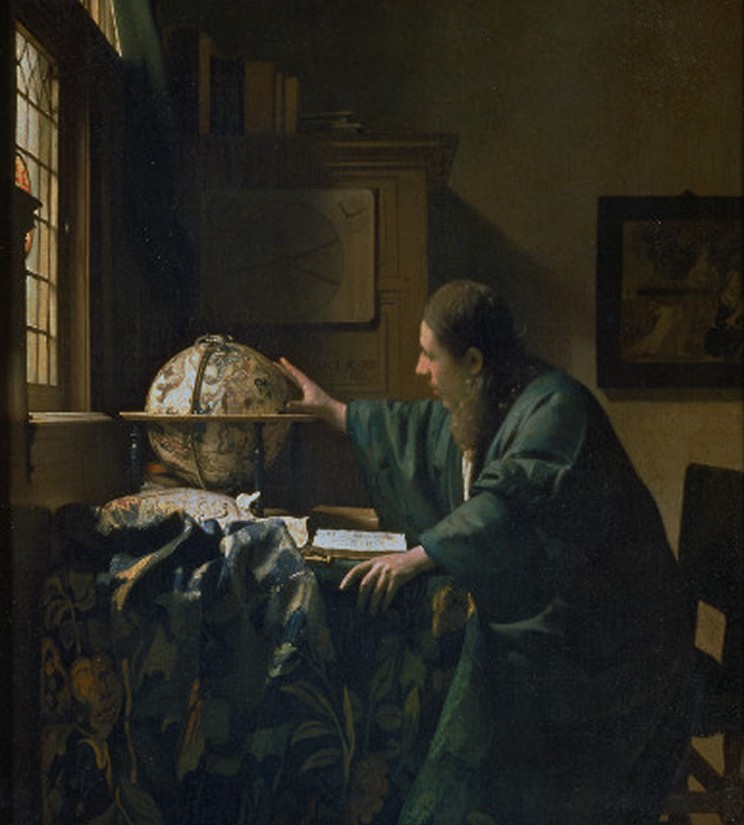
The Astronomer, 1668
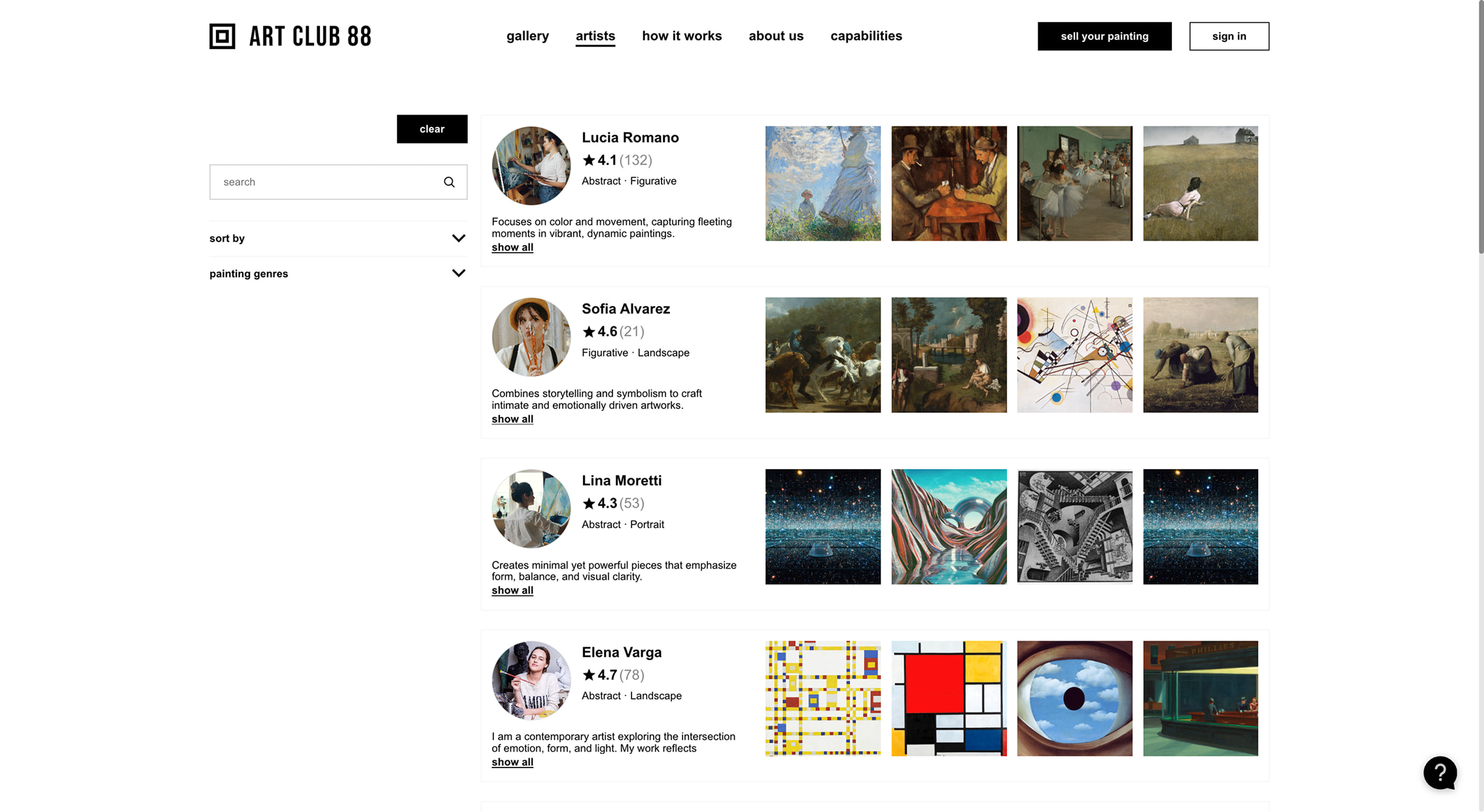
Artists
- Discover verified artists
- Explore unique art styles
- Follow favorite creators
- Order custom art
- Commission custom artwork
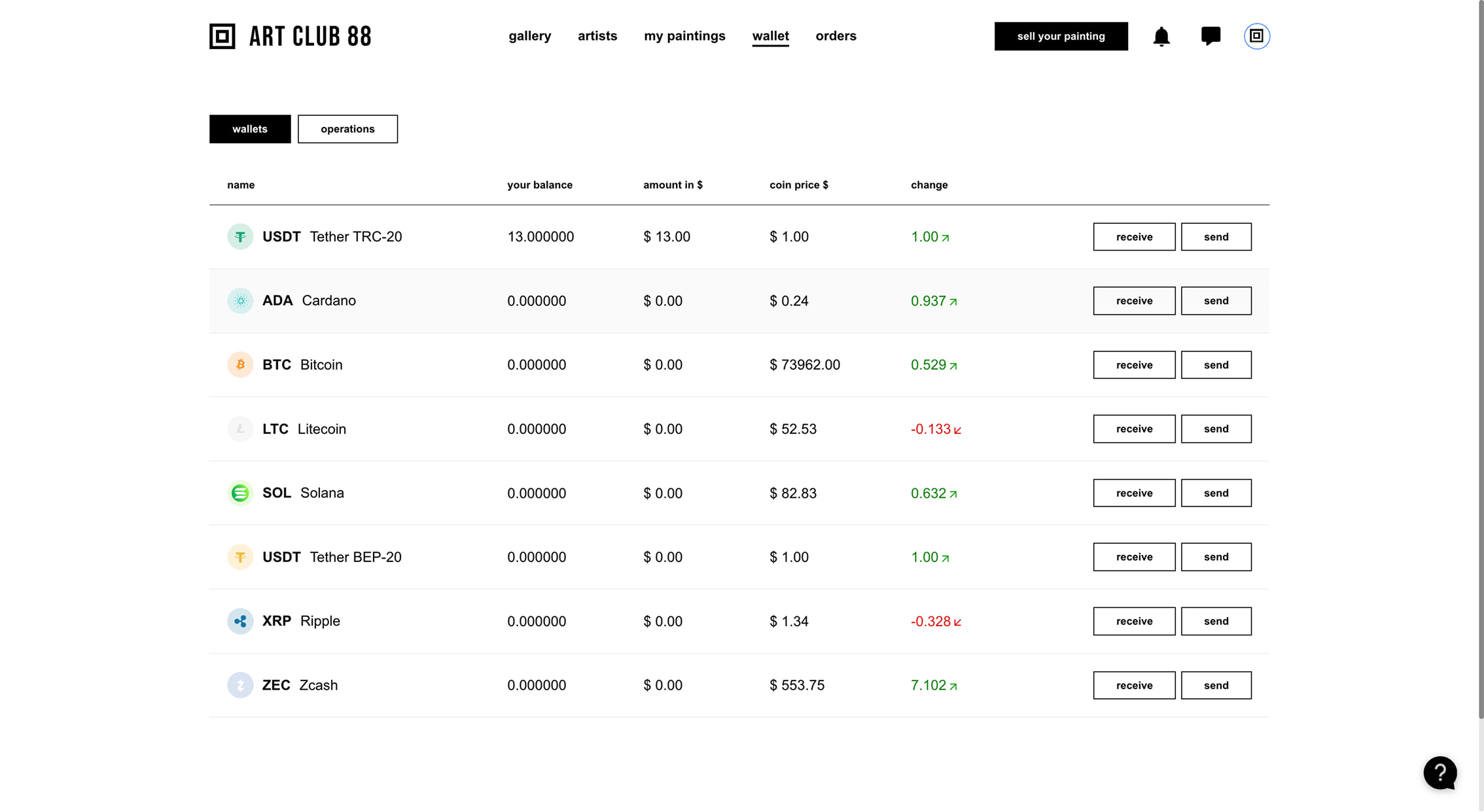
Wallets
- Manage crypto balances
- Send and receive funds
- Track transactions securely
- Monitor asset performance
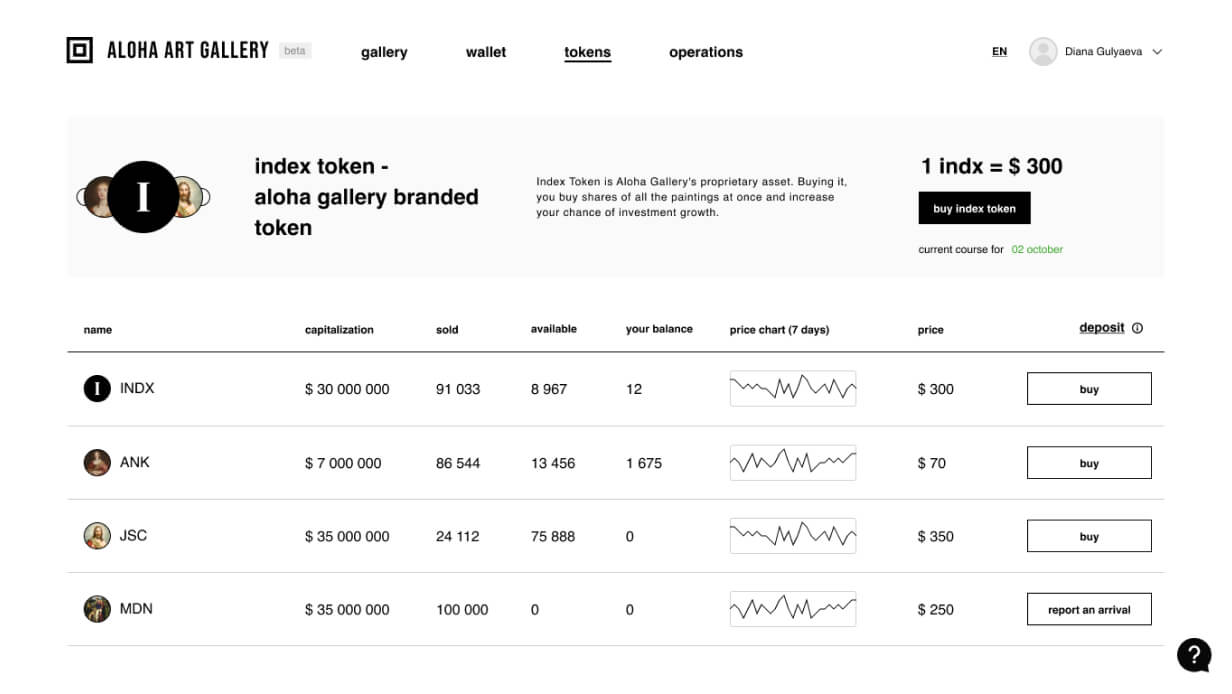
Gallery
- Explore curated collections
- Buy and reserve artworks
- Discover classic masterpieces
- Invest in selected paintings
OWN (A SHARE) OF WORLD-CLASS MASTERPIECES
AND UNLOCK NEW WAYS TO ENGAGE WITH ART
AND UNLOCK NEW WAYS TO ENGAGE WITH ART
ArtClub88 enables a new way of engaging with art, allowing individuals to become co-owners of exceptional works through fractional ownership.
Each artwork is carefully selected and divided into digital shares, opening access to pieces that were once reserved for a limited audience.
Backed by a team of experienced art professionals and supported by modern technology, ArtClub88 ensures accurate valuation and transparency at every stage.
From acquisition to ownership, every step is designed to provide a seamless and secure investment experience.
FAQ
Throughout the entire first stage, the funds remain in the investor’s personal account and are fully under their control.
The second stage is the “implementation of the investment object”. By the beginning of this stage, the investment object must have all documents confirming its authenticity. The investor will have the opportunity to review all materials and decide whether to participate in the implementation or terminate the investment agreement and withdraw their funds.
There may be a situation when the authenticity of the artwork is not confirmed or its market value turns out to be lower than stated. This becomes known before the start of the second stage. In this case, the investor can either withdraw their funds or invest in another object.
To list your artwork, add it through your personal account and fill in the basic information. View the guide
The authenticity of a painting is established through:
Attribution (identifying the author, age, and authenticity) — a comprehensive study that includes three major stages:
- Scientific and Technical (Laboratory) Examination
This is the most important and objective stage. It includes methods that allow determining:
- Chemical composition of paints
- X-ray fluorescence spectroscopy (XRF)
- Infrared spectroscopy (FTIR)
- Gas chromatography–mass spectrometry (GC-MS)
What it reveals: It allows determining which pigments were used. For example:
- Titanium white appeared only in the 20th century.
- Lead white was used until the 19th century.
- Chrome green — since the 19th century.
If a painting is claimed to be from the 16th century but contains a pigment from the 1920s, it is a forgery.
- Analysis of ground layers and binders
Includes examination of:
- type of ground
- oils (linseed/walnut)
- resins
- organic substances
This helps determine the era and sometimes the region.
- Dendrochronology (for wooden panels)
For panel paintings: comparison of tree-ring patterns with dated reference tables. It can determine:
- when the tree was cut
- whether the date corresponds to the period in which the artist could have worked
Example: if the panel was cut in 1650, the painting cannot be from the 15th century.
- Carbon dating (C14)
Used for canvas, wood, and organic grounds.
- X-ray imaging
Reveals:
- underlayers
- corrections
- changes in composition (pentimenti)
- hidden images
Authentic old paintings often contain pentimenti — natural changes made during the creative process.
- Infrared reflectography (IRR)
Reveals:
- underdrawings
- the artist’s original sketch
- characteristic linework
Each master has a recognisable “hand”.
- Ultraviolet fluorescence (UV)
Shows:
- restorations
- later interventions
- new varnish layers
- Chemical composition of paints
- Art Historical (Stylistic) Expertise
Conducted by independent specialists in a specific era or artist. They evaluate:
- painting technique
- composition
- brushstroke
- line quality
- comparison with authenticated works
It is important that the expert is highly specialized (for example, Italian Renaissance).
- Documentary and Historical Expertise (Provenance)
The weakest but still important part. It includes the study of:
- ownership history (provenance)
- archives
- catalogues raisonné
- mentions in museums or exhibitions
- old receipts/photos
If a proven ownership chain exists from the 18th–19th century, the value increases significantly.
- Final Authentication Report
A reputable laboratory provides:
- a technical report
- an art expert’s conclusion
- provenance analysis
- dating
- confirmation or rejection of authenticity
- Scientific and Technical (Laboratory) Examination